
On May 9th 2025, the second session of the academic lecture series "Processing Vibration Control and High-Performance Machining" was successfully held in Room 8b222 of the Modern Transportation Engineering Center. Professor Steven Y. Liang delivered a presentation titled "Active Control of Additive and Subtractive Manufacturing Processes," which was chaired by Professor Liu Gang from the School of Mechanical and Automotive Engineering.
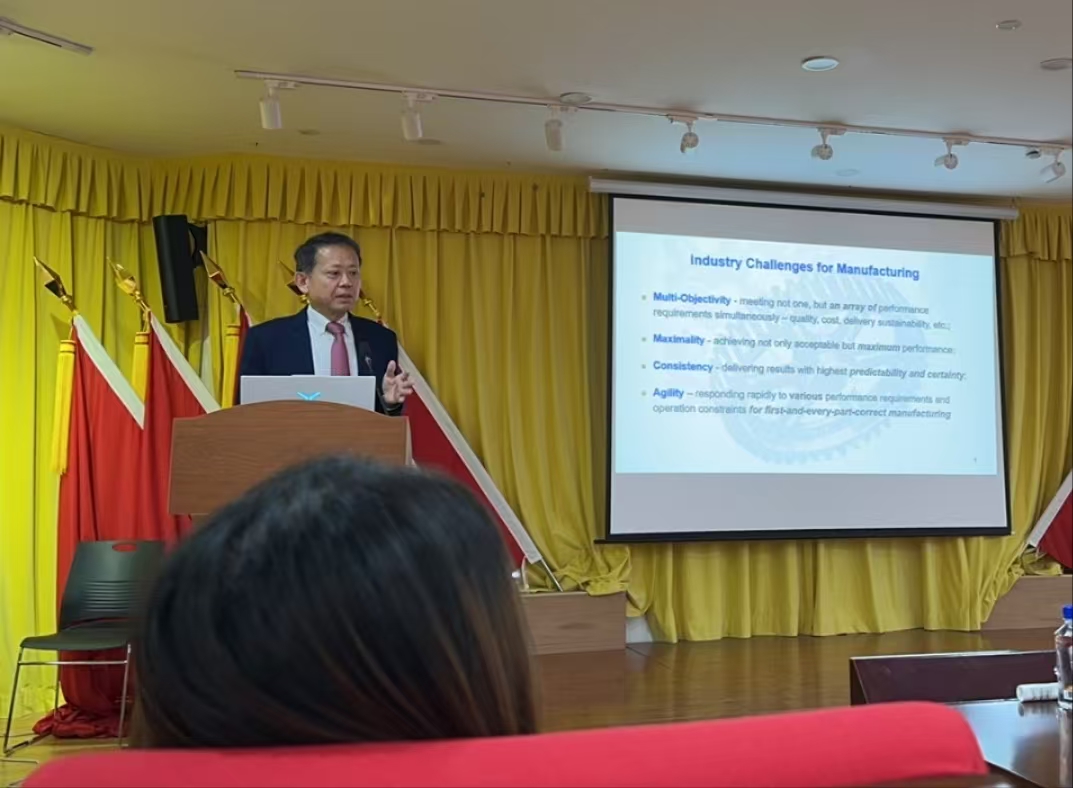
Manufacturing is generally classified into subtractive and additive processes. For both, the predictive modeling capability is critical for the shortening of process development cycle and the overall concept-to-market time as flanked by first-and-every-part-right capability requiring little or no trial-and-errors. This presentation discusses the predictive modeling of both processes based on computational mechanics of materials of meshless and non-iterative nature thereby leading to breakthrough in computational speed and accuracy. In the context of subtractive manufacturing, the effects of thermal, mechanical, tribological, and metallurgical loadings and their interactions are summarized to predict the cutting temperatures, cutting forces and stresses, residual stress, tool life, and aerosol generation as functions of tool geometries and the process parameters. It facilitates the prediction of machining performance and further the optimal planning of machining processes in pursuing maximum performance. In the context of additive manufacturing, closed-form solutions have been established for temperature distributions with boundary thermal balance conditions. Subsequently the in-situ thermal stresses, residual stresses, microstructure, build distortion, porosity, and mechanical properties are expressed as explicit and algebraic functions of process parameters and powder properties, factoring in the details of scan strategy and powder packing. It supports upfront engineering of print strategy for the short and effective process development vital to odd-geometry and extremely low batch productions.